Book lovers know the horror of a beloved book falling apart and shedding pages. It’s heartbreaking! If you’re a prolific reader like me, then you might have read and re-read your books to the point that they’re battered and in need of some repair.
The crucial parts that are usually affected are the ones that hold your book together: the binding and the spine. In this post, we’ll show you what you can do to repair and preserve your book’s binding.
Materials You’ll Need for Book Repairs

We’ll be telling you how to fix three of the most common problems you’ll encounter when it comes to degrading books. Here are the things you’ll need:
- Acid-free glue
- single stitch binder’s tape
- Scissors
- Box cutters
- Cutting mat
- Bone folder
- Weights (you can use any heavy object)
- Long and thin objects (knitting needles, barbecue sticks, etc)
- Wax paper
- A flat piece of plastic (credit or debit cards work fine)
- art brushes
- rubber bands
Video Tutorial on Book Repair
Are you more of a visual learner? Then check out this easy to follow, step-by-step video on how to repair your books.
How to Fix Loose Pages
If your favorite book is in the middle of a physical crisis, then you’ll want to check out the steps below. You might not be a professional at book restoration, but you sure as hell won’t let your cherished possession disintegrate, right?

1. Remove Loose Pages
Carefully take out any loose pages and set them aside so you don’t accidentally damage them during the process. It’s important to be organized here, and stack your pages in a neat pile according to page number. That way, when it’s time to re-attach them, you won’t have to keep sorting through the pages to look for the right one.
2. Apply Glue
Apply a thin, even amount to the inside of the spine, where you need the pages to stick. Spread the glue using a stick or a bone folder.
It’s important to not put too much glue here, because excess glue might make your pages stick together.
3. Reattach Pages
Line up the loose pages so they’re in line with the pages that are still attached to the book. Press the edge of the loose pages that need to be glued into the spine so the whole length comes in contact with the glue.
Make sure that what you’re attaching is the correct set of pages and do the work fast before the glue dries, or the pages will get stuck in the wrong position.
4. Apply Pressure
After all the loose pages have been reattached, close the book and keep the pages in place. You can do this by either wrapping a rubber band horizontally around the book or weighing it down with something heavy. Leave it for a day or two to really ensure that the glue holds.
How to Fix a Spine Gap
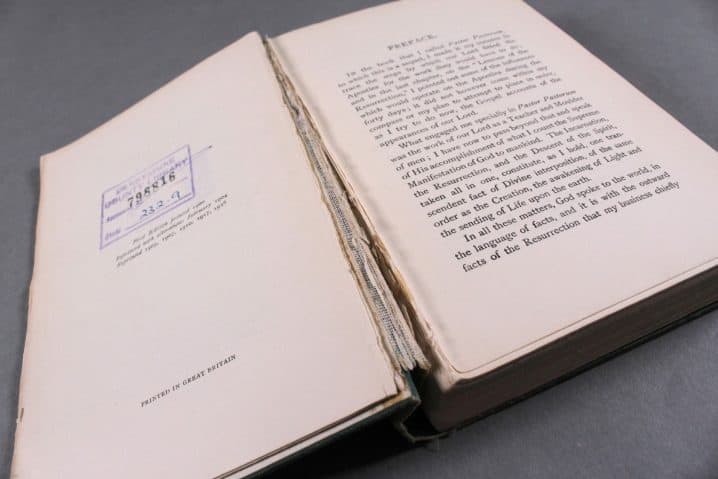
Sometimes the cover spine can detach from the text block, leaving a gap. This can negatively affect your pages’ bindings and your hinges over time. Here are the steps to fixing such a gap.

Stand Book on Its End
Stand the book on it’s end and carefully open up the gap as much as possible without doing any further damage to the book. This will ensure you’ll have plenty of space for the next step.
Apply Adhesive to the Needle
Once you’ve applied glue all over the length of the needle (or whatever you have), insert it into the gap and twirl it around, making sure that the entire length of the inside of the spine and text block are coated in glue.
Lay the Book Flat and Add Waxpaper
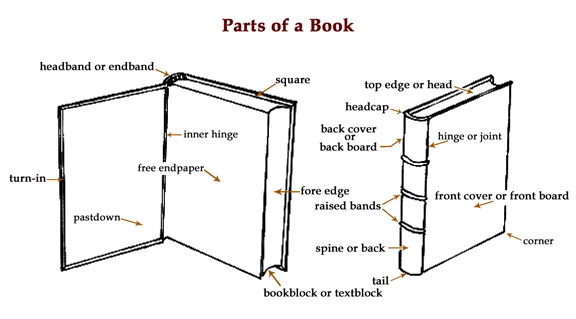
Lay the book flat and gently press the cover spine into the text block and as flat as you possibly can. Use the flat piece of plastic to push the endpapers (the blank pieces of paper that are right after the cover boards) into the spine, making sure that everything’s as square as possible.
Place a piece of wax paper just after both cover boards, and push them as far into the spine as you can. This will prevent any glue from leaking and make sure that your book opens up properly.
Secure the Whole Thing
Lay the book down on a flat surface and place knitting needles into both sides of the spine and along the hinges.
Weigh it down with anything that’s heavy and let dry overnight or more. Once it’s dry, make sure to carefully test opening and closing the book to see if the glue has properly adhered in the right places.
How to Fix a Book Hinge
The hinges (the part between the cover boards and spine that bends to allow you to open a book) can wear away fast from frequently closing and opening a book. Here are a few tips for restoring a disintegrating hinge.
Remove the Hinge
Cut away the hinge so the cover board is fully separated from the book. It’s far easier to fix a detached hinge rather than figuring out how you’ll navigate around an entire book to get at it. Snip off any loose threads or pages. You want a clean surface to work on.
Prepare Your Binder’s Tape
Cut a piece of binder’s tape that’s as long as the text block (the block formed by the book’s pages). It’s important not to cut a piece longer than the text block, or else you’ll end up with too much tape that you’ll need to trim off later on.
Apply Glue
Apply an even amount of glue to one side of the binder’s tape and apply it to the spine of the book by taking hold of the tape’s dry tabs and lining it up to the stitching of the edge of the book. At this point, the binder’s tape will basically have four tabs, two with glue, and two without.
One tab with glue should adhere to the spine of the book and the other on the first page. Take a flat item and rub the tape gently into the book, making sure not to get any creases or air bubbles. Allow the adhesive to dry completely. If it looks and feels wet, then it’s not ready.
Add Wax Paper
Take your wax paper and lay it down at the top of the tab glued to the first page, but below the dry tab. Cut another piece that will fit inside the spine, again laying it flat on top of the glued tab, but below the other dry tab. The wax paper will prevent the glue from sticking to anything it shouldn’t stick to.
Glue Unattached Tabs
Apply adhesive to the remaining tabs. Carefully bring the cover up to fit along with the stitches of the tape, so the cover spine neatly presses into one of the tabs, thereby gluing it from the inside.
Then apply the last tab to the inside of the book cover and smooth it out with your flat instrument.
Secure in Place
Carefully close the book, making sure that everything’s in the right place, and wrap it up horizontally using rubber bands. Let it dry overnight or longer.
The rubber bands will ensure the glue is drying evenly, and that the tabs are flat and securely attached. Once everything is dry, remove the rubber bands and wax paper. Slowly open the book and check that everything’s good.
Remember to open the book slowly for your next few reads to give the book a chance to acclimate to the repair. Suddenly opening the book may result in tearing and pulling.
Common Mistakes When Fixing Book Bindings
Hopefully you’re reading this article before you’ve started the fix. Thousands of amateurs have tried their hands at restoring their cherished books, but they rarely succeed. Here are a few reasons why.
Wrong Products
As I’ve mentioned, a lot of glues and adhesives are acidic, which means they’ll eventually destroy your book if you’ve used the wrong product. You know how tape can turn gooey and melt into whatever it’s sticking to? Yeah, you don’t want that happening to your book.
Not Measuring
A lot of the materials you’ll use in book restoration will come in large sizes that you can trim down to size. The mistake happens when you either forget to leave some allowance for your measurements, or you measure too small.
If you’ve glued them down and realized your mistake afterward, it’s often too late for a redo. Remove the materials and they might just damage your book further. Remember, it’s always easier and safer to measure just a bit more than needed and then trim it down later.
And always measure at least three times!
Not Enough Pressure
Once you’re done measuring, cutting, and gluing everything, whatever you’ve used as a seal needs time to set. Prematurely shelving or opening a recently restored book can render your repair useless.
Use a rubber band or any heavy object to put constant pressure on the book to ensure the seal dries up effectively and cohesively with everything.
Lack of Practice
You’re likely to get tempted to start with the book you need to fix, but if you have no experience, it can easily turn into a disaster. Before trying to restore your beloved book, try practicing on something else.
It’s highly likely you’ll screw up your first few bindings. Get a junk book and some scraps of cheap paper to practice on.
Fixing a Book
There’s always a point where you’ll need to decide whether a repair is worth the effort, or if you should just buy a new book. Keep that in mind when you’re thinking about restoring a book.
But whether a book has value or not, they’re always worth taking care of. Don’t let them get to the point that they’re disintegrating before you take action. Take some pro-active measures, like wrapping them up in protective coverings, or reinforcing the corners.
Because the best thing you can do to care for your books is prevention. Check out some of our tips in storing and preserving your book collection!
Did you ever need to restore one of your books? Share your experience in the comments below!
If you enjoyed this post, then you might also like:
- How to Store Books: The Best Conditions for Storing and Organizing Your Collection
- BookTube: What Is It and Who Should You Be Watching?
- How to Identify and Find Rare Books: Tips for Expanding Your Collection

Cole is a blog writer and aspiring novelist. He has a degree in Communications and is an advocate of media and information literacy and responsible media practices. Aside from his interest in technology, crafts, and food, he’s also your typical science fiction and fantasy junkie, spending most of his free time reading through an ever-growing to-be-read list. It’s either that or procrastinating over actually writing his book. Wish him luck!