
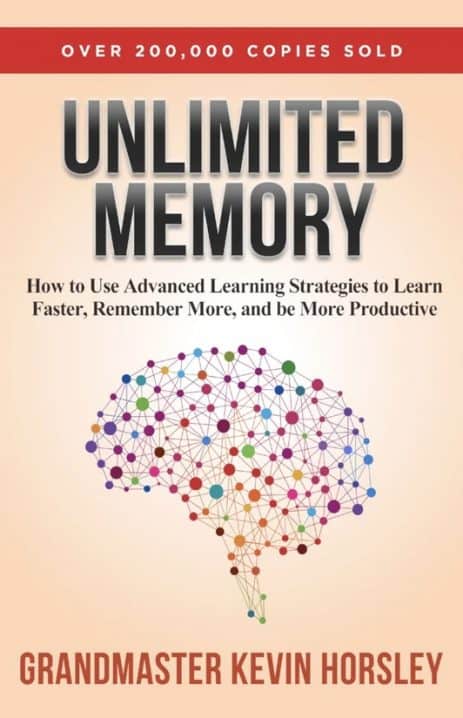
As the publisher of Unlimited Memory: How to Use Advanced Learning Strategies to Learn Faster, Remember More and be More Productive we’re offering limited time free copies of the book to book reviewers.
Simple contact us on our contact page to download your free PDF copy of Unlimited Memory.
You can also purchase the book directly on Amazon or read it free on Amazon with Kindle Unlimited or Amazon Prime through the Kindle Owners’ Lending Library.
Want more free books?
Check out our post on the best websites to download free eBooks.
Unlimited Memory Excerpt
Here’s an excerpt from the beginning of the book:
Introduction
“The great breakthrough in your life comes when
you realize that you can learn anything you need to learn
to accomplish any goal that you set for yourself. This means
there are no limits on what you can be, have, or do.”
~Brian Tracy
What would your life be like if you could learn and remember
information easily, quickly, and effectively? Think about it.
In this short, easy-to-read book, I will provide you with a set of powerful memory-enhancing skills that will allow you to take control of your learning and your life. You will discover many amazing methods, both ancient and modern, in the areas of accelerated learning and memory development.
This book will give you information that school forgot to teach you. These systems require you to think differently than you’re used to. Many people want to improve their memory and concentration, but they continue to use outdated methods they already know, so they don’t get results. You have to do something different to become different.
Imagine you were born without a memory. Who would you be?
You would be nothing; if you didn’t have a memory, you wouldn’t be able to function in our world. Your memory is the glue that binds your life together; everything you are today is because of your amazing memory.
If I asked, “Who are you?” you would immediately start to rearrange memories in your mind to answer the question. You are a data-collecting being, and memory is where your life is lived. If you didn’t have a memory, you wouldn’t be able to learn, think, create, or even tie your shoes. You wouldn’t be able to build experience in any field—because experience is just a collection of memories! Only if you can remember information can you live it.
Over the years, “memory” has come to be associated negatively with rote memorization and cramming information into your brain.
Educators say that understanding is the key to learning, but how can you understand something if you can’t remember it?
Too often, we recognize and understand information when we hear it or read it, but can’t recall that information when we need it. For example, how many jokes do you know? You’ve probably heard thousands, but you can only recall about four or five right now.
There is a big difference between remembering your four jokes and recognizing or understanding thousands.
Understanding doesn’t create use: Only when you can instantly recall what you have understood, and practice using your remembered understanding, do you achieve mastery.
Some people say you don’t need a good memory in the Google age.
Yet Ken Jennings said, “When you make a decision, you need facts. If those facts are in your brain, they’re at your fingertips. If they’re all in Google somewhere, you may not make the right decision on the spur of the moment.”
This raises a question: Would you hire a person for his or her ability to Google information? No. You want people with information and experience at their fingertips. You want confident people that are certain about what they know.
Not storing information in your mind is expensive and can lead to embarrassment and poor judgment. If you must continually refer to notes or manuals to do your work, you will waste time and look unprofessional. Would you allow a doctor to operate on you if she had to continually refer to a manual or an iPad? Definitely not!
Memory means storing what you have learned so you can use it later; otherwise, why would we bother learning in the first place?
